Stative Verbs
2 types of verb: action verbs and non-action verbs (stative verbs).
There are so many action verbs and these verbs can be used in the -ing form (also known as the present participle).
A stative verb describes states of being and these states are often unchanging because they represent situations that last some time.
Action verbs, on the other hand, can change quickly.
One of the most important rules of the stative verb is that these verbs are not used in the -ing form, and the easiest way to learn or practice is by separating some of these verbs in categories.
We’ll begin with these here…
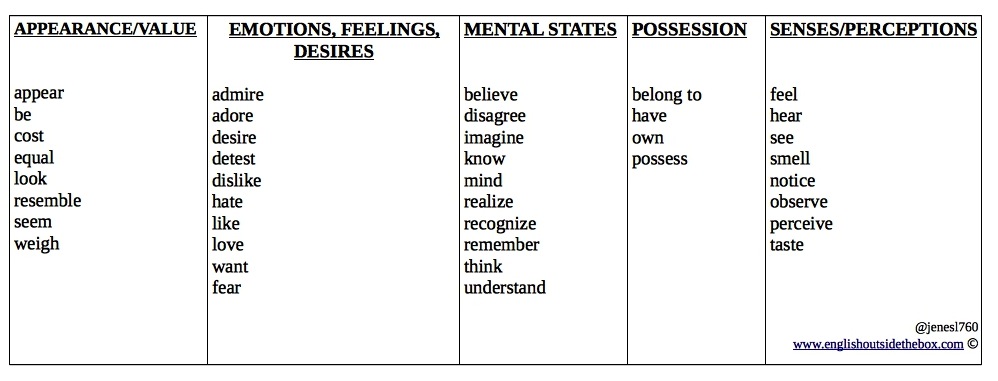
Some of these verbs have more than one meaning.
If the verb has more than one meaning, then yes, it’s very possible for the verb to be both a stative verb and an action verb.
For example: think. When we use it with the meaning to “believe”, then this verb should not be in the -ing form. Our beliefs are things that don’t change too quickly, so these beliefs represent the stative verb (notice it in the “mental states” category on our list). On the contrary, we have the action verb to think, like ”
These thoughts are going through my brain, and as quick as I think of 1 thing, I am quickly moving to another topic. These quick moving (or changing) actions are the reason why this meaning of think is an action verb.
Another common example is the verb have.
When we use it as ownership or possession, it’s stative. And you know what that means, it’s never in the -ing form. Some examples of the stative verb: I have a car. I have 2 cats. I have glasses. I have red hair.
You get the idea? There’s a good chance, though, that you may have heard someone saying, “I am having so much fun!!!” or “I’ll call you later, I am having dinner.”
In the first example, “I am having so much fun”, I am describing what I am experiencing, and this experience can change just as quickly as it started.
I don’t own or possess this “fun” that I am having, so I hope you can see the difference. In the other example, “I am having dinner” I am using “having” the same way I use eating…
Komentar
Posting Komentar